Chandrayaan-1
Chandrayaan-1 was India's historic first deep space mission. Operating 11 scientific payloads from ISRO, NASA, and ESA, it carried the Moon Impact Probe (MIP) which separated on November 14, 2008, striking the lunar south pole near Shackleton crater (named Jawahar Point). The NASA Moon Mineralogy Mapper (M3) aboard confirmed the widespread presence of hydroxyl and water molecules across the lunar regolith, overturning decades of assumptions that the Moon was bone-dry.
Mission Imagery & Gallery
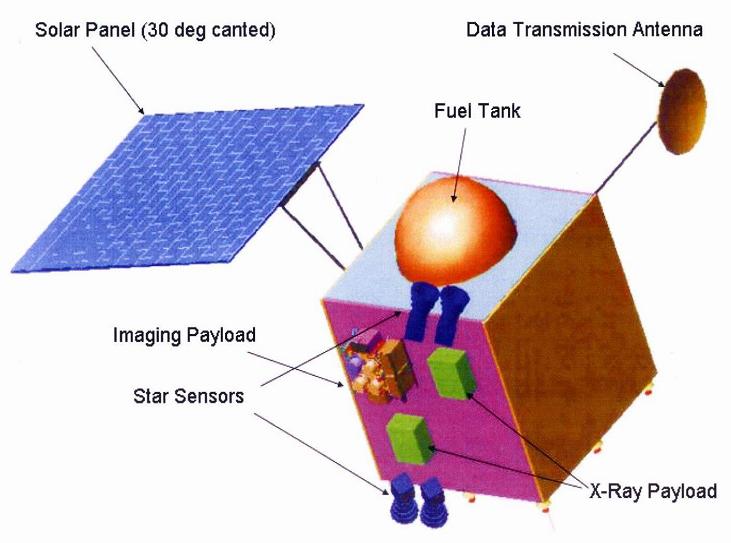
Primary Achievement
India's first lunar mission; its Moon Impact Probe impacted Jawahar Point and Moon Mineralogy Mapper confirmed widespread water molecules on the Moon.
Mission Objectives
- Search for surface and subsurface water ice, particularly in permanently shadowed polar craters
- Execute Moon Impact Probe (MIP) release and telemetry transmission down to impact
- Perform high-resolution chemical and mineralogical mapping of the entire lunar surface
Timeline Events
- 2008-10-22 — Launched from Satish Dhawan Space Centre Sriharikota aboard PSLV-C11.
- 2008-11-08 — Inserted into polar lunar orbit at 100 km altitude.
- 2008-11-14 — Moon Impact Probe (MIP) separated and struck Jawahar Point at 89.55°S, detecting water vapor in transit.
- 2009-09-24 — Science team and NASA formally announced confirmed discovery of water molecules on the Moon.
Related Missions
- Chandrayaan-2 (2019) · ISRO
- Chandrayaan-3 (2023) · India
- LCROSS (2009) · NASA
- Lunar Reconnaissance Orbiter (LRO) (2009) · NASA — orbiter that located the Chandrayaan-1 Moon Impact Probe debris field at the south pole
- Luna 25 (2023) · Russia — also targeted the lunar south pole and crashed, completing no soft landing
Historical & Technical Sources
Ready to view Chandrayaan-1 in 3D?
Interactive 3D Moon viewer with exact site coordinates, sun position, and surrounding topography.
🚀 View Chandrayaan-1 on 3D Moon