LCROSS
LCROSS (Lunar CRater Observation and Sensing Satellite) launched with LRO on June 18, 2009. On October 9, 2009, its spent 2,300-kg Centaur upper stage was guided into a high-speed (9,000 km/h) kinetic impact inside the permanently shadowed region of Cabeus crater at the lunar south pole. The trailing Shepherding Spacecraft flew through the 10-km ejecta plume, measuring near-infrared and ultraviolet absorption spectra that proved the existence of water ice (approx. 5.6% by mass) along with hydrocarbons, ammonia, and CO2, before impacting four minutes later.
Mission Imagery & Gallery
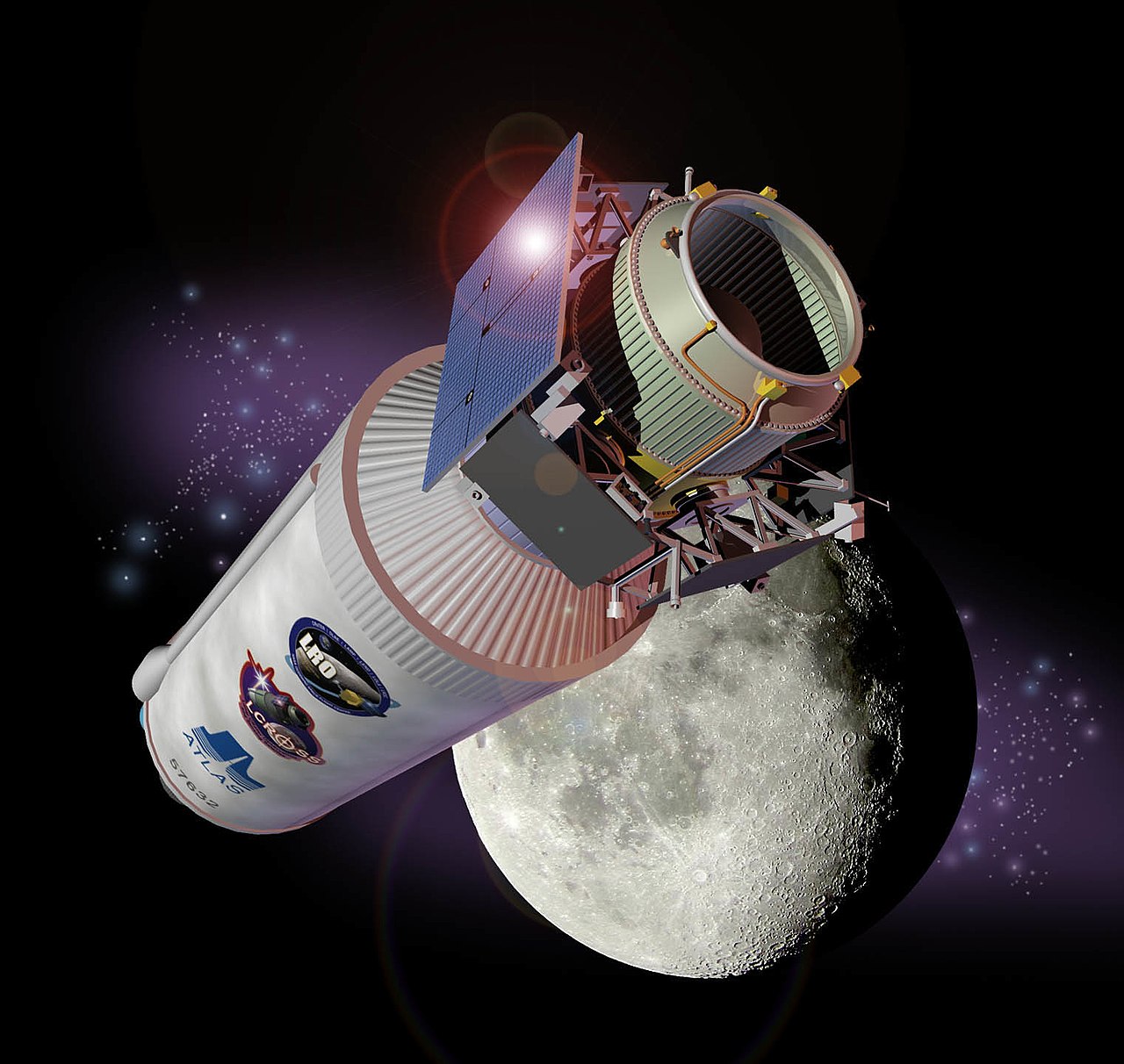
Primary Achievement
Definitively confirmed the existence of pure water ice and volatiles in permanently shadowed regions of Cabeus crater.
Mission Objectives
- Direct kinetic impact of Centaur rocket body into permanently shadowed Cabeus crater floor
- Analyze excavated ejecta plume with 9 spectrometers and cameras during a 4-minute descent
- Confirm concentration and chemical identity of water ice and volatile species in polar cold traps
Timeline Events
- 2009-06-18 — Launched from Cape Canaveral SLC-41 aboard Atlas V rocket.
- 2009-06-23 — Lunar gravity assist placed spacecraft into a 37-day polar Earth orbit inclined to lunar plane.
- 2009-10-09 — Centaur impacted Cabeus crater at 11:31:19 UTC; Shepherding Spacecraft analyzed plume and impacted at 11:35:36 UTC.
- 2009-11-13 — NASA officially announced discovery of significant water ice deposits in the Cabeus ejecta cloud.
Related Missions
- Lunar Reconnaissance Orbiter (LRO) (2009) · NASA
- Chandrayaan-1 (2008) · ISRO
- Lunar Prospector (1998) · NASA
Historical & Technical Sources
Ready to view LCROSS in 3D?
Interactive 3D Moon viewer with exact site coordinates, sun position, and surrounding topography.
🚀 View LCROSS on 3D Moon