Chandrayaan-2
Chandrayaan-2 was launched on July 22, 2019, carrying an advanced Orbiter, the Vikram lander, and the Pragyan rover. The orbiter entered a 100-km polar orbit and continues to operate 8 state-of-the-art instruments, including the highest-resolution optical camera (OHRC at 25 cm) currently orbiting the Moon. During landing on September 6, 2019, the Vikram lander deviated from its trajectory during final braking and hard-impacted 2.1 km from its target between Manzinus C and Simpelius N craters.
Mission Imagery & Gallery
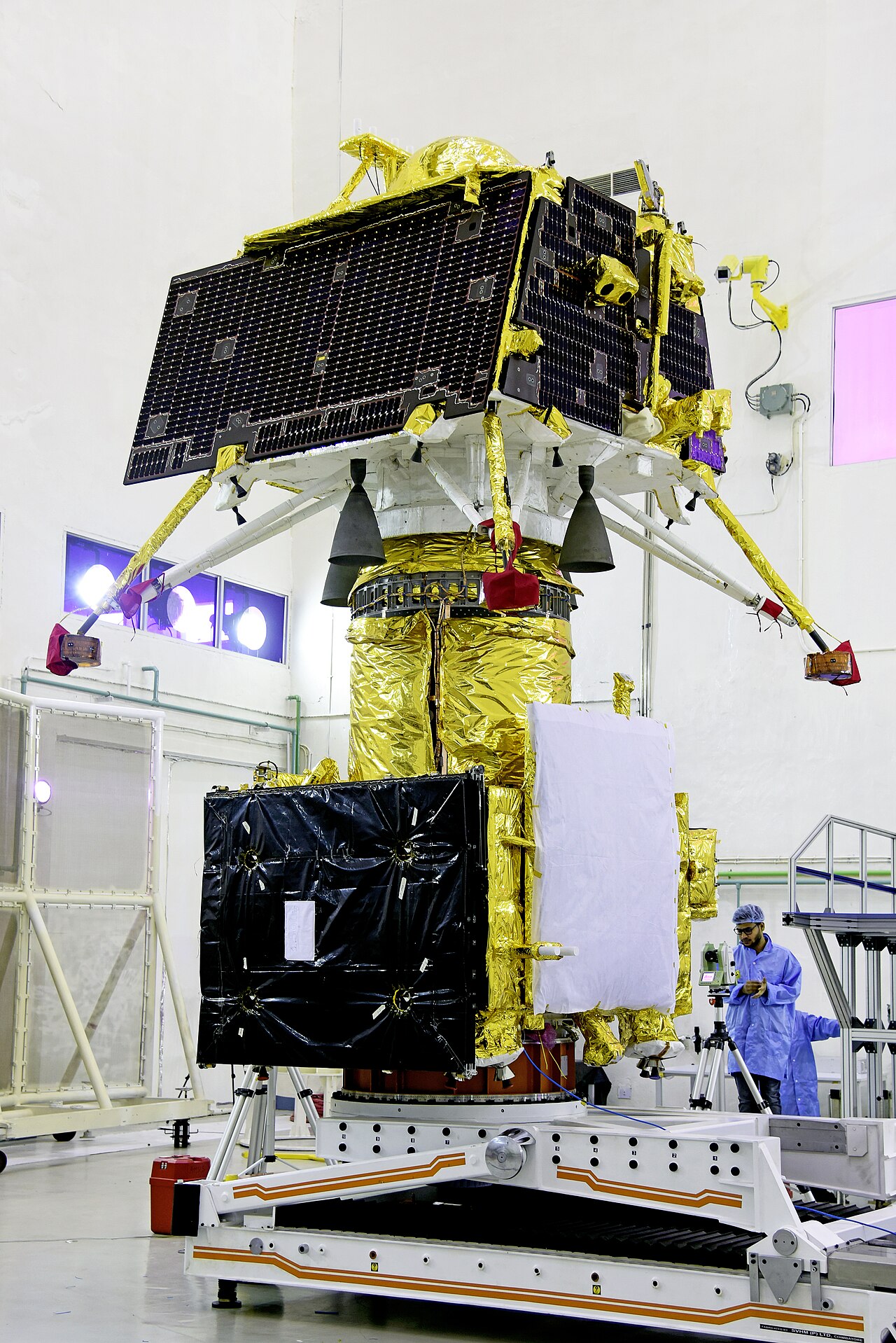
Primary Achievement
High-resolution orbiter continuously operating around the Moon; demonstrated advanced guidance prior to Vikram lander hard impact.
Mission Objectives
- Operate advanced high-resolution orbiter to map mineralogy, elemental abundance, and polar ice
- Attempt soft landing of Vikram lander near the south polar region (70.9°S)
- Deploy Pragyan rover to analyze in-situ chemical composition of the lunar regolith
Timeline Events
- 2019-07-22 — Launched from Satish Dhawan Space Centre aboard GSLV Mk III M1.
- 2019-08-20 — Inserted into polar lunar orbit; Vikram lander separated on September 2.
- 2019-09-06 — Vikram initiated powered descent; lost communications at 2.1 km altitude and impacted surface at 20:23 UTC.
- 2019-12-02 — LRO team and Shanmuga Subramanian located Vikram impact site and debris field.
Related Missions
- Chandrayaan-1 (2008) · ISRO
- Chandrayaan-3 (2023) · India
- Lunar Reconnaissance Orbiter (LRO) (2009) · NASA
- Beresheet (2019) · SpaceIL — Israel's first lunar mission, also crashed on landing in the same year
- Luna 25 (2023) · Russia — similarly targeted the south pole and crashed before landing
- SLIM (2024) · JAXA — Japan's precision lander that successfully reached the south polar zone, contrast to Vikram's crash
Historical & Technical Sources
Ready to view Chandrayaan-2 in 3D?
Interactive 3D Moon viewer with exact site coordinates, sun position, and surrounding topography.
🚀 View Chandrayaan-2 on 3D Moon