Kaguya (SELENE)
Kaguya (SELENE) was Japan's second lunar probe and the most complex lunar exploration mission since Apollo. Launched with two subsatellites (Okina and Ouna), it carried 15 science instruments including twin NHK HDTV cameras that beamed back iconic high-definition video of the Moon and Earthrise. Its laser altimeter mapped global topography with 5-meter vertical precision, its radar sounded the subsurface crust, and its relay satellites mapped the far-side gravity field for the first time.
Mission Imagery & Gallery
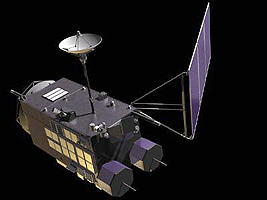
Primary Achievement
Japan's major lunar exploration mission; produced the first high-definition television broadcasts from lunar orbit and comprehensive global topography and gravity models.
Mission Objectives
- Obtain global scientific data on lunar origin, geological evolution, and elemental composition
- Map far-side gravity field and global topography with dual subsatellite Doppler tracking and laser altimetry
- Capture first high-definition HDTV broadcasts of lunar surface and Earthrise from lunar orbit
Timeline Events
- 2007-09-14 — Launched from Tanegashima Space Center aboard H-IIA 2022 rocket.
- 2007-10-04 — Inserted into lunar polar orbit; released relay satellite Okina and VLBI satellite Ouna.
- 2007-11-07 — Broadcast first historic high-definition television video of Earthrise from lunar orbit.
- 2009-06-10 — Deliberately impacted near Gill crater on southeastern near side at 18:25 UTC.
Related Missions
- Hiten (MUSES-A) (1990) · ISAS / JAXA
- Chandrayaan-1 (2008) · ISRO
- Chang'e 1 (2007) · CNSA
- SLIM (2024) · Japan
Historical & Technical Sources
Ready to view Kaguya (SELENE) in 3D?
Interactive 3D Moon viewer with exact site coordinates, sun position, and surrounding topography.
🚀 View Kaguya (SELENE) on 3D Moon