GRAIL (Ebb & Flow)
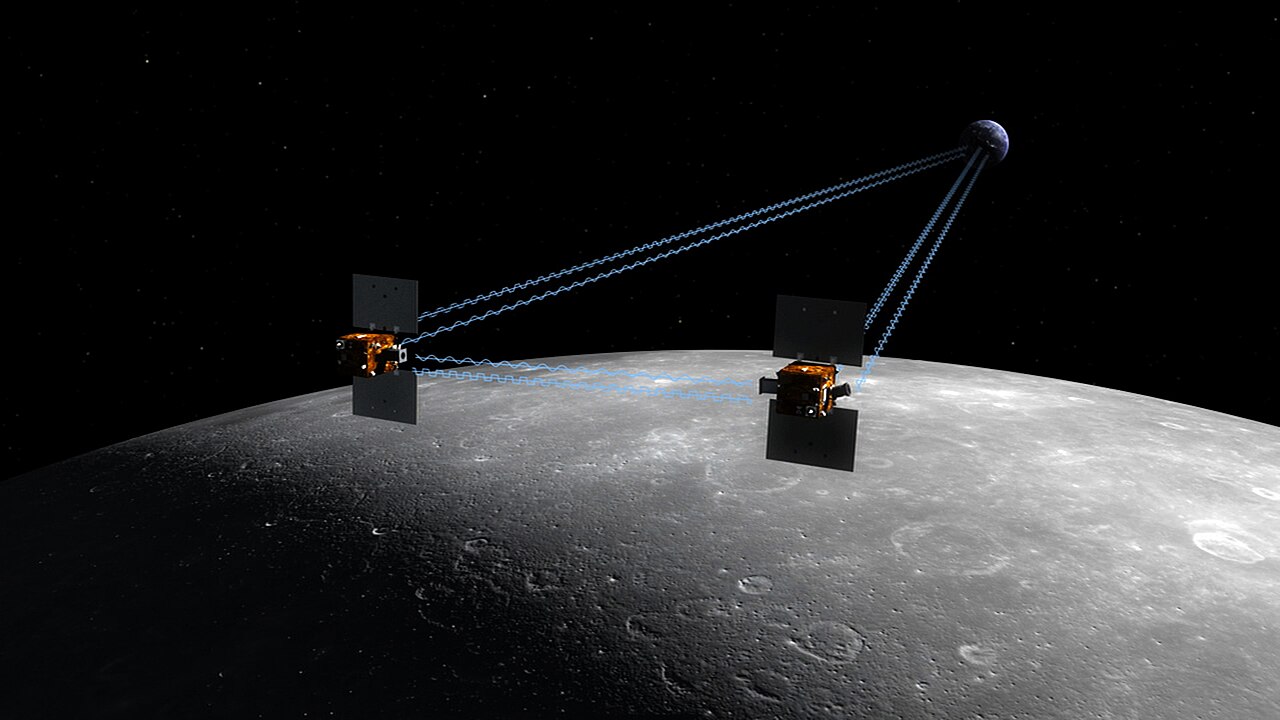
GRAIL (Gravity Recovery and Interior Laboratory) comprised twin spacecraft named Ebb and Flow. Flying in precise tandem at altitudes as low as 23 km, their Ka-band Lunar Gravity Ranging System measured micron-scale distance variations caused by gravitational anomalies. The resulting gravity field map revealed that the lunar crust is thinner and far more intensely fractured by ancient impacts than previously thought. On December 17, 2012, both probes impacted an unnamed ridge near Goldschmidt crater, named the Sally K. Ride Impact Site.
Mission Imagery & Gallery
Primary Achievement
Constructed the highest-resolution gravitational map of the Moon, revealing internal crustal fractures and subsurface structures.
Mission Objectives
- Map high-resolution lunar gravity field with unprecedented spherical harmonic fidelity
- Determine internal structure, crustal thickness, and core size of the Moon
- Investigate thermal evolution and structural impact history of large impact basins
Timeline Events
- 2011-09-10 — Launched from Cape Canaveral SLC-17B on the final flight from this historic pad.
- 2011-12-31 — GRAIL-A inserted into lunar orbit; GRAIL-B followed on January 1, 2012.
- 2012-03-01 — Primary science mapping phase began in 55-km circular polar orbit.
- 2012-12-17 — Controlled impact onto a 2.5-km-high massif near Goldschmidt crater at 22:28 UTC (Sally Ride Site).
Related Missions
- Lunar Reconnaissance Orbiter (LRO) (2009) · NASA
- Lunar Prospector (1998) · NASA
- LADEE (2013) · NASA
Historical & Technical Sources
Ready to view GRAIL (Ebb & Flow) in 3D?
Interactive 3D Moon viewer with exact site coordinates, sun position, and surrounding topography.
🚀 View GRAIL (Ebb & Flow) on 3D Moon