Luna 1 (Mechta)
Luna 1 (originally nicknamed 'Mechta' or Dream) was launched on January 2, 1959. It became the first human-made object to reach Earth escape velocity and fly past the Moon at a distance of 5,995 km on January 4. During flight, it released a sodium gas cloud creating an artificial comet visible from Earth, proved the Moon lacked a significant dipole magnetic field, and discovered the solar wind stream.
Mission Imagery & Gallery
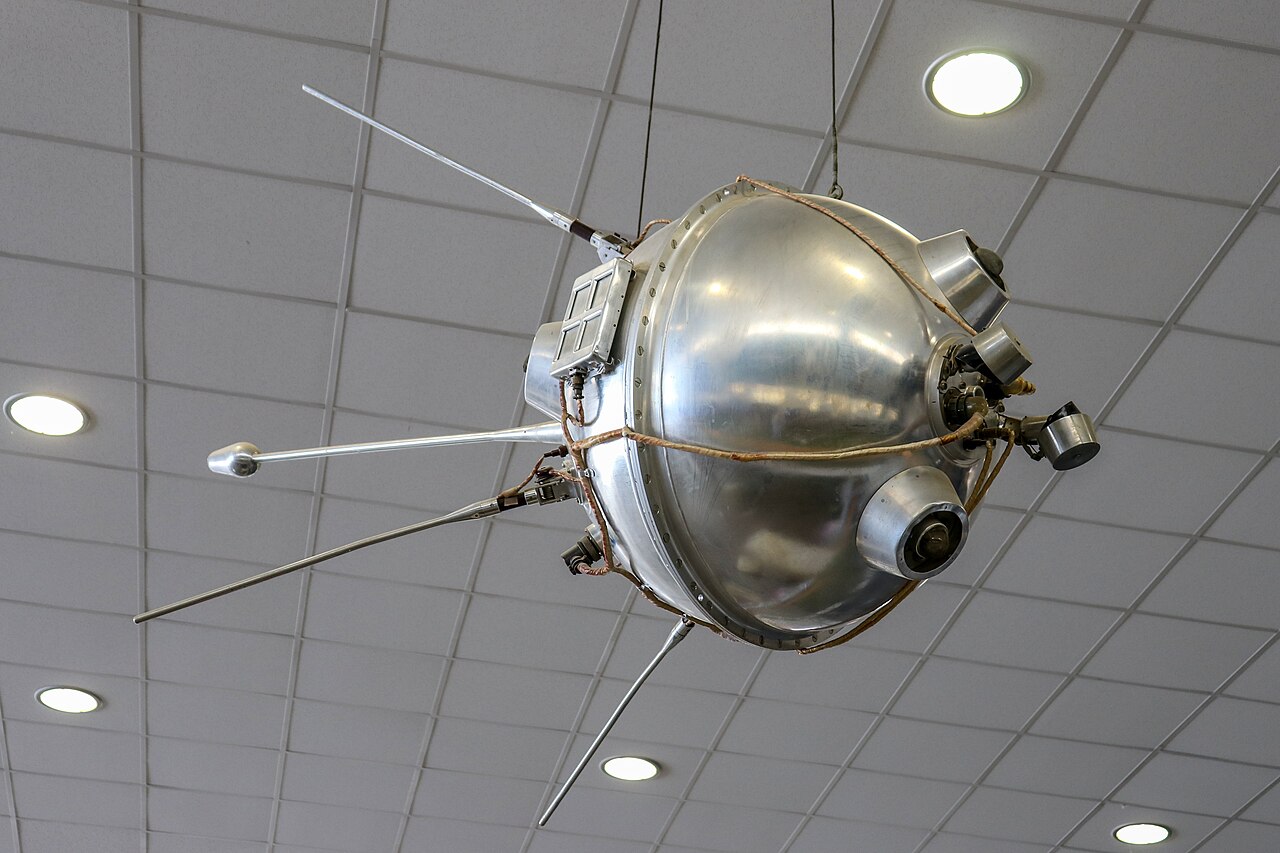
Primary Achievement
First spacecraft to reach the vicinity of the Moon and achieve Earth escape velocity, entering heliocentric orbit.
Mission Objectives
- Achieve Earth escape velocity and trajectory to the Moon
- Measure interplanetary magnetic fields and radiation in cislunar space
- Detect presence of lunar magnetic field and evaluate solar wind particles
Timeline Events
- 1959-01-02 — Launched from Baikonur Cosmodrome aboard Luna 8K72 rocket.
- 1959-01-03 — Released orange sodium vapor cloud at 119,700 km from Earth, creating artificial comet for tracking.
- 1959-01-04 — Closest approach to Moon (5,995 km) at 02:59 UTC, becoming first object in solar orbit.
Related Missions
- Luna 2 (1959) · Soviet Space Program
- Luna 3 (1959) · Soviet Space Program
- Luna 9 (1966) · USSR
- Luna 13 (1966) · USSR — second Soviet soft landing, continuing the program Luna 1 pioneered with the first Earth-escape flight
- Ranger 7 (1964) · NASA — the US equivalent first-impact mission that competed with USSR in the same Cold War lunar race
- Hiten (MUSES-A) (1990) · ISAS — Japan's historic first lunar mission, echoing Luna 1's status as a national spaceflight milestone
Historical & Technical Sources
Ready to view Luna 1 (Mechta) in 3D?
Interactive 3D Moon viewer with exact site coordinates, sun position, and surrounding topography.
🚀 View Luna 1 (Mechta) on 3D Moon